
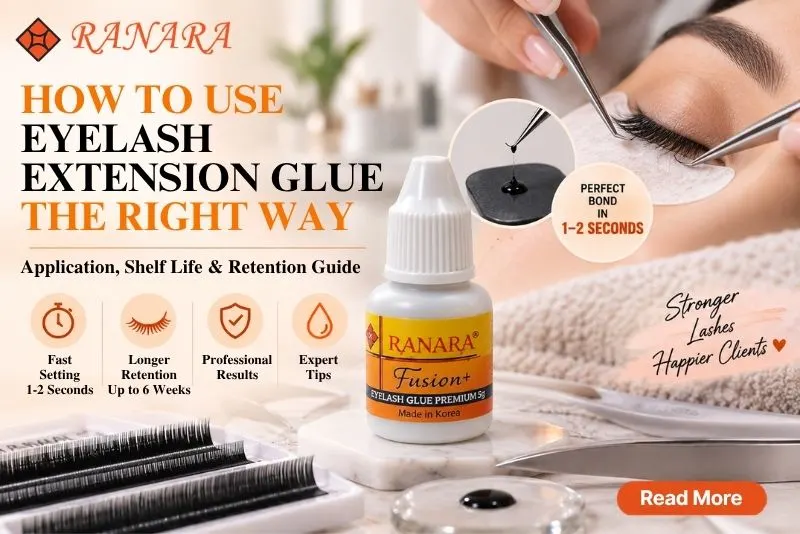
If a client’s lash extensions keep lifting, flaking, or falling out within a few days, the adhesive itself is rarely the only problem: how it’s used usually is. Eyelash extension adhesive is a fast-curing cyanoacrylate formula that’s extremely sensitive to technique, humidity, temperature, and freshness. Get any one of those wrong and even a premium adhesive will underperform.
Lash technicians who train other artists see the same pattern again and again: people blame the glue when the real issue is prep, environment, or storage. Understanding why an adhesive behaves the way it does is what separates a technician who gets consistent 5- to 6-week retention from one who’s constantly troubleshooting.
This guide walks through how to use professional eyelash extension glue correctly, how an air-dry adhesive differs from a traditional tacky-set adhesive, how long an opened or unopened bottle actually lasts, and the specific habits that improve, or quietly kill, lash retention.
What Is Eyelash Extension Adhesive, Exactly?
Professional lash extension adhesive is built on a cyanoacrylate base. This is the same chemical family as super glue, reformulated to be safer near the eye, with additives that control flexibility, drying speed, fume level, and color (clear vs. black). Because cyanoacrylate cures by reacting with moisture in the air, two things affect it more than anything else: humidity and how thin and even the layer is when applied.
Adhesive chemistry, not brand loyalty, is what actually determines retention. Once you understand the cure reaction, you stop guessing and start controlling the results.
Air-Dry Adhesive vs. Tacky-Set Adhesive: Know the Difference
Not all lash adhesives cure the same way, and mixing up the two techniques is one of the most common causes of a botched set.
- Tacky-set adhesives (common with strip lashes and some older extension formulas) need a short waiting period after application. You apply the glue, wait roughly 20 to 30 seconds for it to turn tacky, and only then press the lash into place. Placing it too early, while the glue is still wet, causes slipping and uneven bonding.
- Air-dry adhesives, like Ranara Eyelash Glue Fusion+, work differently. There is no tacky waiting stage to time. The extension is dipped, placed onto the isolated natural lash almost immediately, and the adhesive sets in the air as the technician holds it in position, typically in just 1 to 2 seconds.
Skipping this distinction is a common source of technician error: waiting for an air-dry formula to “go tacky” the way you would with a different adhesive type simply wastes working time and can affect how cleanly the bond forms. With an air-dry formula, speed and correct isolation matter more than timing a wait.
How to Use Ranara Eyelash Glue Fusion+ (Professional Application)
This is the process taught to professional lash technicians for applying extensions with a fast-setting, air-dry adhesive.
- Prep the client’s natural lashes. Cleanse thoroughly with an oil-free lash cleanser and apply a bonding primer to remove any residual oil; this single step has the biggest impact on retention.
- Isolate one natural lash using isolation tweezers so the extension bonds to a single lash, not several stuck together (which causes premature shedding as lashes shed on their own natural cycle).
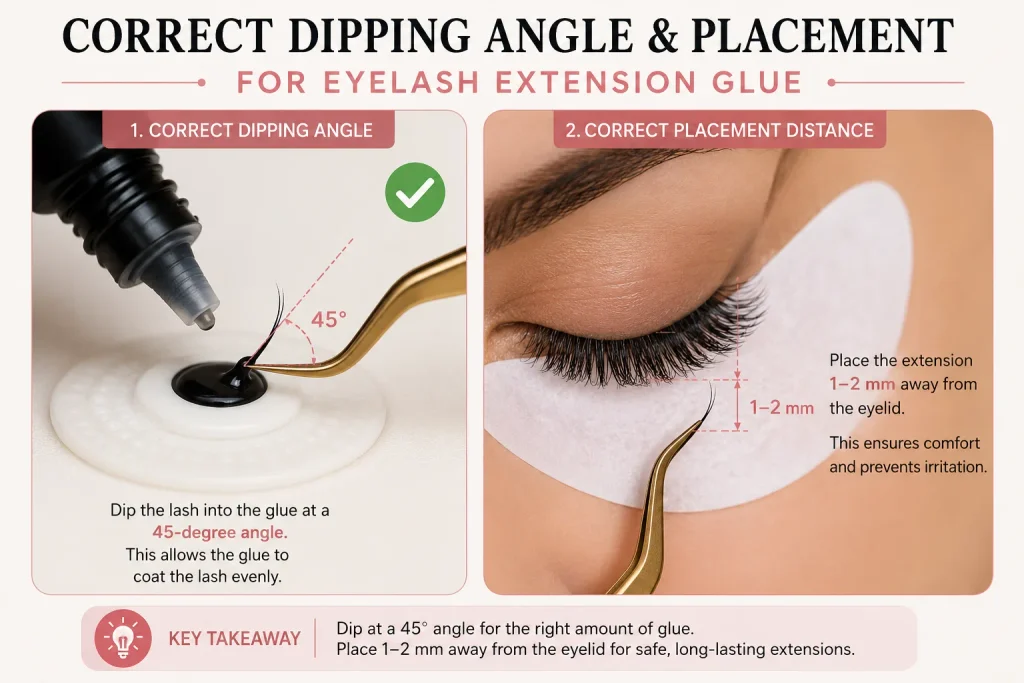
- Dip the extension base into the adhesive at a 45-degree angle to coat the lash evenly, never a dripping or globbed tip.
- Place the extension immediately, about 1 to 2mm from the lid margin, without letting it touch the skin, and attach it to the isolated natural lash using the “wrapping” technique so the glue fully surrounds the lash base. Because this is an air-dry formula, there’s no tacky stage to wait out first — place it while it’s fresh.
Shake the adhesive bottle for about 30 seconds before first use, and give it a shorter shake before each subsequent use. Settled cyanoacrylate cures unevenly and weakens the bond. It’s one of the most overlooked steps, even among experienced technicians, and it costs nothing to fix.
How Long Does Eyelash Extension Glue Last?
This question has two different answers, depending on what you mean: how long the extensions last on the client (wear time) or how long the bottle itself stays usable (shelf life). Here’s both.
How long a professional extension set lasts
| Application | Typical Wear Time |
| Professional eyelash extensions | 3 to 6 weeks, following the natural lash growth cycle |
Wear time depends heavily on technique and aftercare, not just the adhesive. Oil exposure, humidity, rubbing the eyes, and how well the extensions were isolated all shorten or extend how long a set actually holds, regardless of which glue was used.
How long the bottle itself lasts (shelf life)
This depends entirely on whether the bottle is sealed or opened, so the two numbers are very different.
| Condition | Typical Shelf Life |
| Unopened, stored correctly | Up to 12 months from manufacture date |
| Opened, stored correctly (refrigerated) | Up to 2 months, used regularly |
| Opened, used only occasionally | Can degrade faster than the date suggests; air exposure matters more than the calendar |
Shelf life is one of the most under-taught topics in the lash industry. Technicians who track their opened-bottle date consistently report far fewer retention complaints than those who don’t. It’s a five-second habit with an outsized payoff.
Why opened glue expires so much faster than unopened glue
Cyanoacrylate cures by reacting with moisture in the air. The moment you open the bottle, every use exposes the adhesive inside to humidity, and a thin layer begins curing inside the nozzle itself. Over weeks, this:
- Thickens the consistency and slows drying time
- Reduces bond strength, even if the glue still “works”
- Eventually clogs the nozzle entirely
How to store eyelash extension adhesive to make it last longer
- Keep the bottle upright, capped tightly, and away from direct light and heat.
- Store opened glue in the refrigerator, as the formula requires.
- Never store it in a freezer; condensation on rewarming does more damage than room-temperature storage.
- Let refrigerated glue return to room temperature before use, since applying cold adhesive slows curing and weakens the bond.
- Wipe the nozzle after every use before recapping to stop dried glue from sealing it shut.
Signs your eyelash extension glue has gone bad
- Consistency turns stringy, clumpy, or unusually thick
- It stays tacky far longer than usual, or won’t set at all
- A strong, sour, or ammonia-like smell replaces the usual scent
- The glue won’t come out of the nozzle even after cleaning
- Extensions applied with it lift or fall within a day or two, despite good technique
If two or more of these show up, replace the bottle: using degraded adhesive is the single most common cause of poor retention complaints, and it can irritate sensitive eyes.
How to Improve Lash Extension Retention: 9 Practical Tips
Show Image
Retention issues are rarely about one thing; they’re usually a combination of technique, environment, and aftercare. Here’s what to check first:
- Remove all oil before application. Oil-based skincare, makeup, or natural sebum is the #1 cause of early lash loss. Use an oil-free cleanser and primer beforehand.
- Apply a thin, even glue layer. Too much adhesive traps moisture inside and takes longer to fully cure; too little won’t hold. Thin and even wins every time.
- Control room humidity. Most professional adhesives are formulated for roughly 40 to 60% humidity. Very dry air slows curing; very humid air over-cures the surface while the inside stays wet.
- Keep working temperature moderate. Higher heat speeds up drying time (sometimes too fast to work with), while cooler temperatures slow it down. Fusion+ is designed for working temperatures up to around 22°C.
- Avoid touching or rubbing lashes for the first 24 to 48 hours. This is the true curing window: water, steam, and friction during this period are the top causes of premature lifting.
- Isolate properly during application. Two natural lashes bonded together as one will shed together, taking the extension with the natural lash before its cycle is done.
- Brush lashes daily with a clean spoolie. This prevents tangling and helps you catch lifted lashes early before they snag on others.
- Skip oil-based makeup removers and heavy creams near the lash line. Oil breaks down cyanoacrylate bonds over time, even weeks after application.
- Use fresh adhesive, not glue that’s been open for months. Even the best formula loses hold strength as it ages after opening; see the shelf-life section above.
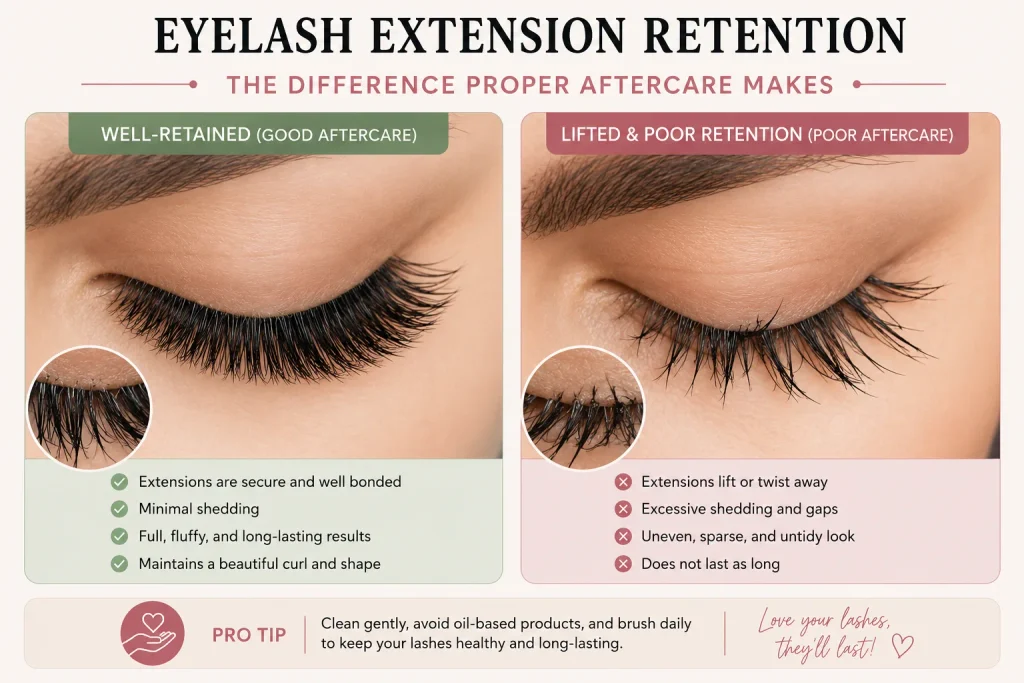
Retention is a system, not a single product. Technique, storage, and environment all have to work together, and that’s what separates a technician with consistently high retention from one who’s constantly troubleshooting one variable at a time.
What to Look for in a High-Retention Extension Adhesive
Once technique, storage, and environment are dialed in, the adhesive itself is the remaining variable. A few things separate a genuinely reliable formula from an average one:
- Set/dry time: 1 to 2 seconds is considered fast-setting and ideal for continuous professional application.
- Cure mechanism: know whether you’re working with an air-dry formula or a tacky-set formula, since the two require different placement timing.
- Stated retention window: look for adhesives that specify a realistic retention period (e.g., up to 6 weeks) rather than vague “long-lasting” claims.
- Odor and fume level: lower-fume, odorless formulas are gentler for both technician and client during longer sessions.
- Consistency for your climate: humid regions generally do better with a fast-setting formula, while drier, air-conditioned studios may prefer a touch more working time.
A formula that clearly states its cure mechanism, set time, retention window, fume level, and shelf-life guidance is generally a safer bet than one relying on vague “long-lasting” marketing claims.
Ranara Eyelash Glue Fusion+: A Formula Built Around These Standards
Ranara Eyelash Glue Fusion+ is a professional-grade, air-dry eyelash extension adhesive designed to meet the checklist above, rather than just one or two points on it:
- Cure type: Air-dry—no tacky waiting stage, sets as it’s held in place
- Set time: 1 to 2 seconds, fast enough for continuous professional application (as fast as 1 second in warm conditions, up to 2 seconds in cooler conditions)
- Stated retention: Up to 6 weeks
- Formula: Black, odorless, low-fume, 5g
- Unopened shelf life: 12 months
- Opened shelf life: Up to 2 months, when refrigerated and the nozzle is cleaned after each use
- Best working temperature: Up to around 22°C, suited to most air-conditioned studio environments
👉 View Ranara Eyelash Glue Fusion+ product details and pricing →